You Escaped the PIP. So Why Does Your Body Still Think You're Still There?
You left the job that put you on a PIP. You got a new one, a safer one. So why do you still flinch before a 1:1, still replay the day in your head at midnight? Your body isn't malfunctioning — it just hasn't caught up yet.
"I got out. So why does it still feel like I'm still there?"
You did the hard part. You survived the PIP, or you left before it finished you off. You interviewed, you got an offer, you started somewhere new — somewhere that, by every reasonable measure, is safer.
And yet.
Your stomach still drops before a 1:1. You still rehearse what you're going to say to your new manager, even when there's nothing to defend. You still lie awake replaying today's meeting, hunting for the sentence that might have sounded wrong. A message that just says "got a sec?" still makes your chest tighten for a full second before you remember: this isn't that job anymore.
Some days you feel almost guilty about it. You got the fresh start. People would kill for this. So why can't you just… relax into it?
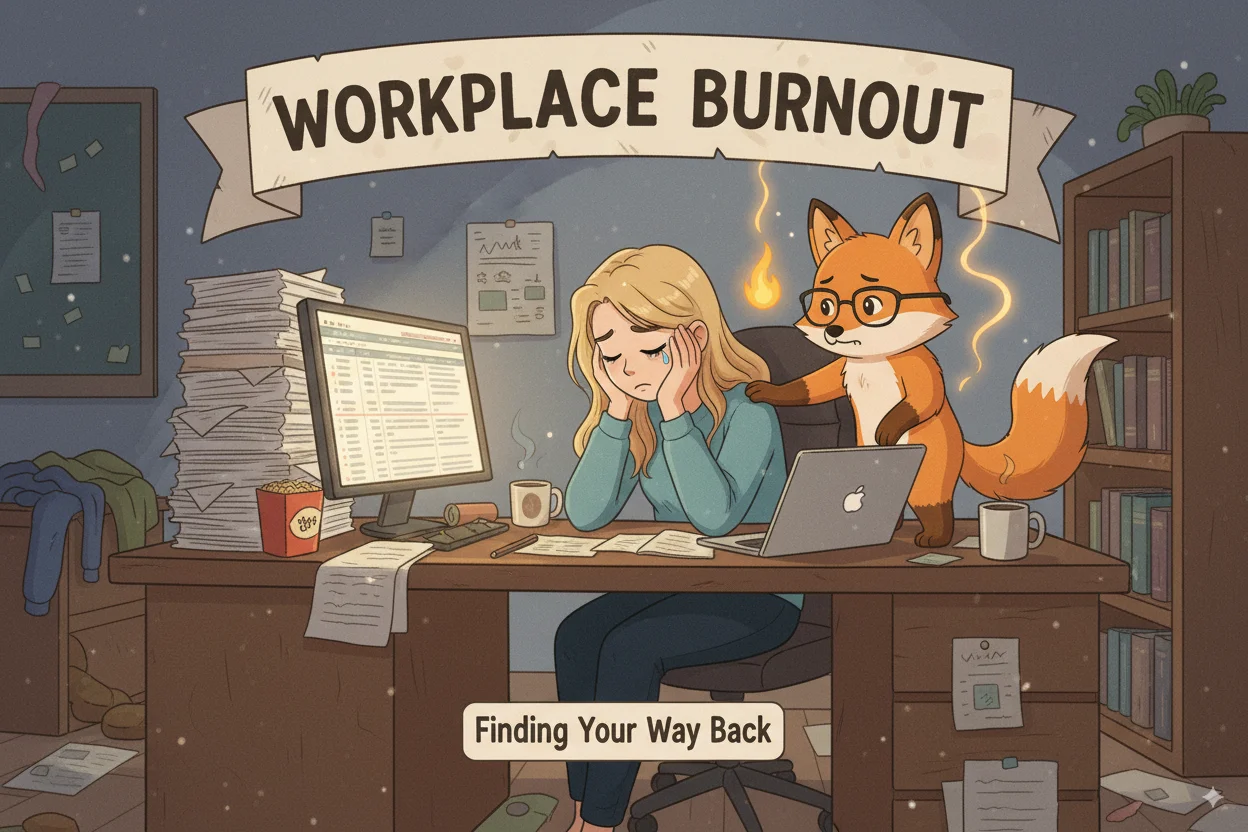
settles in beside you, doesn't rush this part 🦊
Here's what I want you to hear first: there is nothing wrong with you. Your body isn't failing to appreciate your good fortune. It's doing something much older and much smarter than that — it's still running the only safety protocol it has, because as far as your nervous system is concerned, that protocol worked. It got you out alive. It hasn't been told, in a language it trusts, that it's allowed to stand down.
Your body doesn't know the difference between "that job" and "a job"
When you were going through the PIP — the moving goalposts, the meetings that felt like ambushes, the manager whose messages made your stomach drop before you'd even opened them — your nervous system learned something. Not a fact you could recite, but a pattern it now runs automatically: authority figure + feedback + uncertainty = danger.
That pattern doesn't come with a footnote saying "only applies to that specific manager, at that specific company, during that specific eight-month window." It generalises. It has to — that's what a threat-detection system is for. It would rather flag ten false alarms than miss one real one.
So when your new manager says "can we chat for a sec," your body doesn't pause to check the org chart. It just runs the pattern it already has on file, because the surface features match closely enough: a person with power over your job, wanting to talk to you, on their schedule, not yours.
This is why you can know, intellectually, that this job is different — better manager, healthier team, no PIP in sight — and still feel your chest tighten anyway. Knowing and feeling live in different parts of you, and the feeling part doesn't update on logic. It updates on repeated, lived evidence that the new pattern is safe.
This isn't weakness. It's also not permanent.
I want to say this plainly, because I know how it sounds from the inside: it can feel like you're broken, or ungrateful, or like you brought your old job's poison with you into a clean space and are quietly ruining it.
You didn't ruin anything. What you're carrying is called anticipatory anxiety, and it's one of the most common, most under-discussed parts of recovering from a genuinely bad work experience. It shows up in people who left toxic jobs for markedly better ones — sometimes especially in people who left for better ones, because a calm environment gives your nervous system enough quiet, for the first time in months, to notice it's still braced for impact.
It's also not a life sentence. The nervous system that learned "this is dangerous" can learn "this is actually different" — but it needs the same thing it needed the first time around: repeated, felt evidence, not a pep talk. Time helps. So does actively collecting the evidence, rather than waiting for your body to notice it on its own.
Helping your body learn the new pattern
None of this is about forcing yourself to "just relax" — that almost never works on a nervous system, and it usually just adds a layer of self-judgment on top of the fear that was already there. What tends to actually help is smaller and slower than that.
Name the difference out loud, every time you notice it. When your new manager responds to a mistake with a shrug instead of a slammed door, say it to yourself — even just in your head: "That's not what happened last time. That's new information." You're not trying to talk yourself out of the fear. You're giving your nervous system a data point it can file under "different," one small piece of evidence at a time.
Expect the flinch, don't fight it. Before a 1:1 or a review, it's fair to assume some part of you will brace anyway, for a while. That's not a sign you're not healed. Bracing and then noticing you're safe, over and over, is actually how the unlearning happens — it's the repetitions that count, not whether you flinched in the first place.
Give it a real timeframe, not an instant one. Recovery from a genuinely bad work experience isn't measured in weeks. Depending on how long the original situation ran and how it ended, it's often several months before a new workplace starts to feel reliably safe in your body, not just on paper — and that's with things going well. If you're three weeks into a new job and still jumpy, that's not behind schedule. That's on schedule.
Say it out loud to someone. Not to be talked out of it — just so it stops living only in your head, replaying at midnight with no witness. A friend, a partner, a therapist, or a space like the SisiTheFox Healing Companion that's built specifically for this kind of aftermath. You are far from the only person carrying this — people who left one toxic role for a genuinely better one describe this exact thing constantly: new office, new manager, new country sometimes, and the same midnight replay of the day. Knowing that doesn't erase the feeling, but it does take away the extra layer of "what's wrong with me" that makes it heavier than it needs to be.
Let small joys stay small. You don't need this new job to feel completely safe before you're allowed to enjoy a good day in it. A kind comment from a colleague, a project that went well, a manager who said thank you and meant it — let those count on their own, even while the wariness is still there in the background. They're not proof you're cured. They're just proof, one at a time.
You're not carrying the old job into this one. You're still setting it down.
If there's one thing I'd want you to leave with, it's this: the fact that your body hasn't caught up yet doesn't mean the escape didn't work. It worked. You're out. What you're feeling now isn't the toxic job following you — it's the tail end of it, the part that takes longer to leave than your resignation letter did.
You don't have to rush this. You don't have to perform being fully okay for a workplace that, this time, actually deserves your trust — you just have to keep letting it earn it, one ordinary, undramatic day at a time.
A Few Honest Answers
Is it normal to still feel this way months into a new, better job? Yes — more common than most people realise, precisely because they don't talk about it. The body's alarm system doesn't check your employment contract before it fires.
How do I know if this is normal recovery or something I need more help with? If it's easing, even slowly, and you can name genuine good moments alongside the wariness, that's the normal shape of this kind of healing. If it's getting worse, staying constant with no easing at all after several months, or coming with panic attacks, intrusive flashbacks, or thoughts of self-harm, please talk to a therapist or your GP about a Mental Health Care Plan — that's not "too much," that's the right next step.
Will I ever stop bracing before every 1:1? Most people find the bracing fades rather than disappears all at once — quieter, shorter, less physical over time, as more evidence piles up that this workplace isn't that one.
If You Need Somewhere to Land
Free Resources:
- Emergency Calm Kit — grounding techniques for the moment the old fear spikes, at www.sisithefox.com/free-resources
Personalised Support:
- Workplace Wellbeing Pack — a 21-day system built for exactly this kind of aftermath: evidence-gathering practices, grounding tools, and an AI companion that doesn't need the backstory explained twice
If today feels heavier than usual:
- Lifeline: 13 11 14
- Beyond Blue: 1300 22 4636
Related Reading
- The Fox's Sanctuary: Healing from Workplace Bullying — for healing while you're still in it, or just after you've left
- Sunday Scaries: Why You Dread Monday — when the dread creeps back on weekends too
- Not Every PIP Is About Your Performance — Here's How to Tell — the practical companion piece, for understanding what actually happened
- Before You Sign That PIP — if someone you know is still in the middle of it
Wherever you are in this — still catching your breath, or three jobs down the line and still surprised by the flinch — you don't have to explain it to me. I already know.
With you in this, Fox 🦊
This content provides emotional support and educational information based on psychological research and lived experience. It is not a substitute for professional mental health care. If you're experiencing severe anxiety, depression, or thoughts of self-harm, please contact Lifeline (13 11 14), Beyond Blue (1300 22 4636), or your nearest emergency department.
Need a reading, not another tab?
If this question feels personal, Sisi can help you read the pattern and choose a next move.
Start reading